Medically Reviewed by Dr. Kiran Nerkar | MBBS, DNB (Aesthetic and Plastic Surgery), MNAMS — Board-Certified Plastic & Aesthetic Surgeon, Aakar Aesthetics Clinic, Nashik
Introduction — Why Male Breast Reduction Is Among the Fastest-Growing Cosmetic Procedures
Male breast reduction surgery has quietly become one of the most sought-after cosmetic procedures for men in India and worldwide. According to data from the International Society of Aesthetic Plastic Surgery (ISAPS), gynecomastia surgery ranks in the top five cosmetic procedures for men globally, with demand increasing by over 30 percent in the last decade.
The reason is straightforward. Gynecomastia the medical term for enlarged male breasts —affects an estimated 40 to 60 percent of men at some stage of their lives. For many, it is not just about appearance. It is a condition that limits clothing choices, discourages physical activity, and creates persistent self-consciousness that follows men into every area of their lives.
If you are reading this, you probably already know that exercise and diet cannot fix it. That is because true gynecomastia involves glandular tissue—firm tissue beneath the nipple that responds only to surgical removal.
This guide covers every practical detail about the procedure: what happens before, during, and after surgery; the different surgical techniques and which one suits your case; how much it costs in Nashik with a grade-wise breakdown; the full recovery timeline, including when you can return to the gym; and what your results will look like at each stage. Everything here is reviewed by Dr. Kiran Nerkar, a board-certified plastic surgeon specializing in male chest contouring at Aakar Aesthetics Clinic, Nashik.
For a deep dive into the safety profile of this surgery, including complication rates, risk factors, and medical evidence, read our companion article:Is gynecomastia surgery safe? Risks, benefits, and expert insights.
What Is Male Breast Reduction Surgery?
Male breast reduction surgery—clinically known as reduction mammoplasty for gynecomastia—is a procedure that removes excess breast tissue, fat, and in some cases skin from the male chest to restore a flat, firm, and naturally masculine contour.
What sets this apart from general liposuction or other body-contouring treatments:
- It targets glandular tissue specifically. Standard liposuction only removes fat cells. In true gynecomastia, the enlargement is caused by firm glandular tissue (often combined with fat). This gland must be surgically excised—it cannot be suctioned out through standard liposuction alone.
- It is a contouring procedure, not just a removal. The goal is to sculpt the chest into a shape that looks naturally masculine—with proper chest definition, proportional nipple placement, and smooth transitions to the surrounding torso.
- It addresses the complete chest unit. A skilled surgeon considers the chest wall shape, the nipple-areola complex, fat distribution, and skin elasticity to deliver a result that looks balanced and natural from every angle.
The surgery typically takes 1 to 2.5 hours and is almost always a day-care procedure—you go home the same day. Results are visible immediately and continue improving as swelling subsides over 3 to 6 months.
What Causes Gynecomastia? Understanding Why It Happens
Identifying the cause helps your surgeon plan the most effective approach and ensures lasting results.
Hormonal Imbalance
The most common cause. Gynecomastia develops when the ratio of estrogen to testosterone shifts in favor of estrogen. This imbalance can occur during puberty, in middle age as testosterone naturally declines, or due to medical conditions affecting hormone production.
Pubertal Gynecomastia
Up to 70 percent of adolescent boys develop some breast enlargement during puberty. It usually resolves within 1-3 years. When it persists beyond age 18, it is unlikely to resolve on its own and surgical correction becomes the recommended path.
Medications and Substances
Known triggers include:
- Anabolic steroids—the most common cause in young men who work out (steroids convert to estrogen, stimulating breast tissue)
- Anti-anxiety medications—certain SSRIs and benzodiazepines
- Heart and prostate medications—calcium channel blockers, finasteride, spironolactone
- Chronic marijuana and alcohol use—can disrupt hormone balance
Obesity
Fat cells convert androgens to estrogen, potentially causing pseudogynecomastia (fat-only enlargement) or worsening true gynecomastia. Whether your enlargement is fat-based, gland-based, or both directly determines the surgical technique. For a detailed comparison, read our article on chest fat vs. true gynecomastia.
Medical Conditions
Less common but important to rule out: liver disease, kidney failure, thyroid disorders, and certain tumors can cause hormonal shifts leading to gynecomastia. A thorough medical evaluation, including blood tests, is a critical part of the pre-surgical process.
How Gynecomastia Is Diagnosed—The Clinical Process
Accurate diagnosis is the foundation of a good surgical outcome. Here is how Dr. Kiran Nerkar evaluates patients at Aakar Aesthetics Clinic:
Step 1: Physical Examination
The surgeon examines your chest while standing, assessing the size, shape, and distribution of tissue. A key test is the pinch test—the surgeon gently pinches the tissue behind the nipple to distinguish firm glandular tissue (feels rubbery and disc-shaped) from soft fatty tissue. This simple examination tells the surgeon whether you have true gynecomastia, pseudogynecomastia, or a combination.
Step 2: Medical History Review
Your surgeon asks about:
- When the enlargement first appeared and how it has changed
- All current medications and supplements
- Any history of steroid use or recreational substances
- Family history of gynecomastia or hormonal disorders
- Any tenderness, nipple discharge, or recent weight changes
Step 3: Blood Tests
A standard panel includes:
- Hormonal profile: Testosterone, estradiol, LH, FSH, and prolactin—to identify any hormonal imbalance that caused the condition or that needs to be treated alongside surgery
- Thyroid function: TSH, T3, T4—thyroid disorders can contribute to gynecomastia
- Liver function: AST, ALT, bilirubin—liver disease affects hormone metabolism
- Complete blood count and coagulation profile: Ensures you are fit for surgery with no bleeding risk
Step 4: Imaging (When Needed)
In most cases, the physical examination is sufficient. However, if the surgeon suspects an unusual cause, an ultrasound of the breast tissue may be ordered to visualize the tissue composition and rule out any abnormalities. A mammogram is rarely needed but may be recommended in older patients or if there are atypical findings.
Step 5: Grade Classification
Based on all the above, your surgeon classifies your gynecomastia into one of four grades — which directly determines the surgical approach.
Not sure what grade your gynecomastia is? Dr. Kiran Nerkar provides a thorough clinical examination, blood tests, and honest assessment of your condition during your first consultation. Book Your Diagnosis Consultation →
The 4 Grades of Gynecomastia—Where Do You Stand?
The Simon classification system divides gynecomastia into four grades. Your grade determines everything—from the surgical technique to the expected recovery time and cost.
Grade 2 is the most common presentation in Dr. Nerkar's practice, and it responds excellently to the combination technique with consistently natural-looking results.
Types of Gynecomastia Surgery—Liposuction vs. Excision vs. Combination
1. Liposuction
Best for: Pseudogynecomastia (fat-only) or Grade 1 with predominant fatty tissue.
How it works: A thin cannula (2-4 mm) is inserted through 1-2 tiny incisions in the armpit or areola edge. The cannula breaks up and suctions out excess fat. Advanced methods like VASER or power-assisted liposuction (PAL) enable more precise sculpting.
Incisions: 3-4 mm entry points—virtually invisible within weeks.
Recovery:Fastest of all techniques. Most patients return to work in 3-5 days.
Limitation: Cannot remove firm glandular tissue. If a gland is present, liposuction alone will leave a hard lump beneath the nipple.
2. Gland Excision (Subcutaneous Mastectomy)
Best for: True gynecomastia where firm glandular tissue is the primary component.
How it works: A semicircular incision along the lower edge of the areola allows the surgeon to directly visualize and excise the glandular mass. The incision follows the natural color transition at the areola border.
Incisions: Periareolar—nearly invisible once healed because it sits on the color boundary.
Advantage: Directly removes the root cause. Ensures the gland responsible for enlargement is completely eliminated.
Limitation: Does not address surrounding fat. Usually combined with liposuction for optimal contouring.
3. Combination Surgery (Liposuction + Gland Excision)
Best for: Grades 2, 3, and 4—the majority of surgical cases.
How it works:Liposuction is performed first to remove fat and create initial contouring. Then the glandular tissue is excised through a periareolar incision. For Grade 3-4, excess skin may also be removed and the nipple repositioned.
This is the most commonly performed technique at Aakar Aesthetics because most patients present with both glandular and fatty tissue.
Quick Comparison Table
VASER Liposuction for Gynecomastia — The Advanced Option
VASER (Vibration Amplification of Sound Energy at Resonance) is an advanced liposuction technology that has significantly improved results in gynecomastia surgery over the last decade.
How VASER Works
Unlike traditional liposuction that mechanically breaks up fat with a cannula, VASER uses ultrasonic energy< to selectively liquefy fat cells while preserving surrounding blood vessels, nerves, and connective tissue. The liquefied fat is then gently suctioned out.
Why VASER Is Particularly Good for Gynecomastia
- Superior skin retraction: The ultrasonic energy stimulates collagen production in the skin, promoting natural tightening. This is especially valuable in Grade 2-3 cases where mild skin laxity exists—VASER may eliminate the need for separate skin excision.
- Smoother contouring: The selective fat removal allows the surgeon to create more precise, smooth chest contours with fewer surface irregularities compared to traditional liposuction.
- Less tissue trauma: Because VASER targets fat cells specifically, it causes less damage to blood vessels and nerves. This translates to less bruising, less swelling, and potentially faster recovery.
- Better definition: For patients who want a more sculpted, athletic chest appearance, VASER allows the surgeon to etch muscle borders and create definition that standard liposuction cannot achieve.
VASER vs. Traditional Liposuction for Gynecomastia
Dr. Nerkar determines whether traditional or VASER liposuction is more appropriate based on the individual patient's tissue composition, skin quality, and aesthetic goals.
What Happens on Surgery Day — Minute by Minute
Here is exactly what to expect on the day of your procedure:
Before Arriving (At Home)
- Nothing to eat or drink for 6-8 hours before your scheduled time
- Wear a loose, front-button shirt — you will not want to pull anything over your head afterward
- Do not apply any deodorant, perfume, or body lotion
- Arrange for a family member or friend to drive you home
- Leave jewelry, watches, and valuables at home
At the Clinic — Pre-Surgery (30-45 minutes)
- Arrival and check-in: Paperwork, consent forms, final questions
- Change into surgical gown: Personal belongings are secured
- Pre-surgical marking: Dr. Nerkar marks your chest while you are standing, mapping out tissue removal areas and the target contour. These markings serve as a precise surgical roadmap
- IV line placement: A nurse places an intravenous line for fluids and medication administration
- Meet the anesthesiologist: The anesthesiologist reviews your medical history, explains the anesthesia plan, and answers any last questions
In the Operating Room (1-2.5 hours)
- Anesthesia administration (10-15 min): Local with sedation (you are relaxed but awake) or general anesthesia (completely asleep). Continuous monitoring begins — heart rate, blood pressure, oxygen, breathing
- Sterilization and draping (10 min):The surgical area is cleaned with antiseptic solution and sterile drapes are placed
- Liposuction phase (30-45 min): If applicable, tumescent fluid (saline + lidocaine + adrenaline) is infused to numb the area and reduce bleeding. The liposuction cannula removes excess fat while the surgeon sculpts the chest contour
- Gland excision phase (30-45 min): The periareolar incision is made. The glandular tissue is carefully dissected and removed. The surgeon checks symmetry by comparing both sides during the procedure
- Hemostasis and closure (15-20 min):All bleeding points are cauterized. Small drains may be placed (removed in 24-48 hours). Incisions are closed with absorbable sutures. A compression garment is fitted immediately
Recovery Room (2-3 hours)
- Anesthesia wears off gradually under nurse supervision
- Vital signs are monitored until fully stable
- Light liquids are offered once you are alert
- Pain medication is administered as needed
Discharge
- Prescription for antibiotics and pain medication
- Written aftercare instructions with emergency contact numbers
- Follow-up appointment scheduled for day 5-7
- You are driven home by your companion
Want to see real patient transformations?
Browse before-and-after photos and patient testimonial videos from surgeries performed by Dr. Kiran Nerkar at Aakar Aesthetics. View Gallery & Videos →
Complete Recovery Protocol — Week by Week
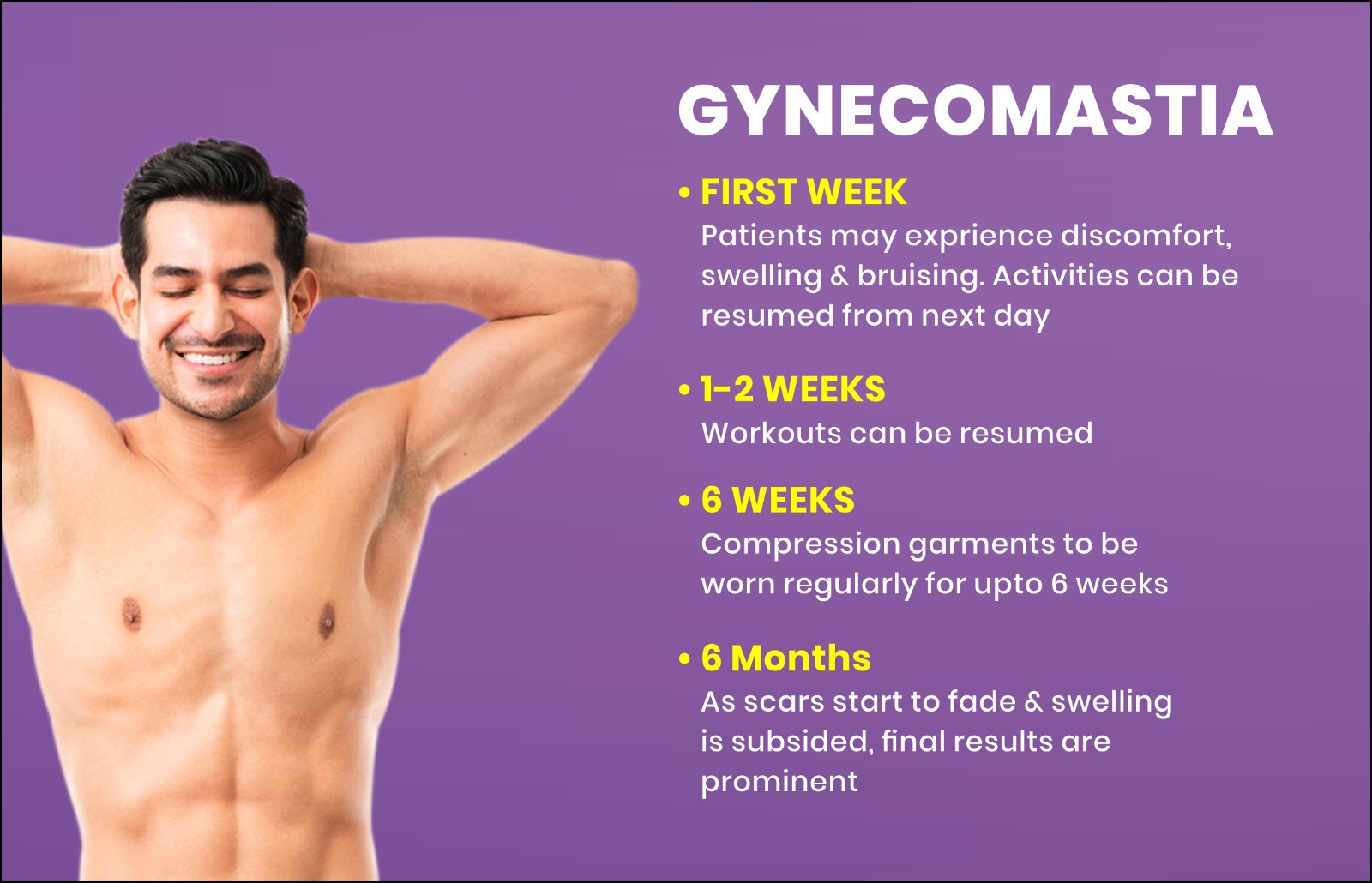
Recovery is faster and more comfortable than most patients expect. Here is a detailed timeline:
Day 1-3: Rest Phase
- Mild to moderate soreness—similar to post-workout chest ache, easily managed with prescribed painkillers
- Compression garment worn 24/7 (remove only for bathing)
- Light walking around the house encouraged (prevents blood clots)
- Avoid raising arms above shoulder height
- Sleep on your back, slightly elevated with pillows
- Ice packs on the chest for 15-20 minutes every few hours (reduces swelling)
Day 4-7: Early Return
- Most patients feel well enough for desk work or remote work by day 5:
- Swelling peaks around day 3-4 then begins declining
- First follow-up visit — surgeon checks incisions, removes drains if placed
- Can shower carefully (avoid direct water pressure on incisions)
- Bruising (if any) begins changing color and fading
Week 2-3: Normalizing
- Can drive, shop, run errands
- Compression garment may shift to daytime-only (per surgeon guidance)
- Chest contour visible through clothing—the "flat T-shirt" moment many patients look forward to
- Light lower body exercises may resume (walking, stationary bike)
- Numbness around the nipple begins improving
Week 4-6: Active Recovery
- Most physical activities resume, including light upper body exercises
- Swelling reduces progressively—the chest becomes more defined each week
- Scars are pink but already beginning to flatten
- Compression garment gradually discontinued
- Can wear fitted T-shirts and shirts with confidence
Month 2-6: Final Result
- Full gym activity including chest press, push-ups, and swimming (with surgeon clearance)
- All residual swelling resolves
- Scars continue fading—at 6 months they are faint lines at the areola edge
- A final sculpted, masculine chest contour is achieved
For more details on the latest techniques that speed up recovery, read new advances in gynecomastia surgery and recovery insights.
The Compression Garment Guide
The compression garment directly affects the quality of your final result. Here is everything you need to know:
What It Does
- Controls swelling by applying even pressure, helping fluid drain naturally
- Promotes skin retractionby keeping skin in close contact with the newly contoured chest wall
- Prevents seroma (fluid pockets) by eliminating dead space beneath the skin
- Stabilizes the surgical area during movement, reducing discomfort
- Protects incision sites from external pressure or friction
Wearing Schedule
Practical Tips
- Wear a thin cotton vest underneath to absorb sweat and prevent skin irritation
- Have two garments so you can wash one while wearing the other
- The garment should feel snug but not painfully tight—if it leaves deep marks or restricts breathing, inform your surgeon
- Do not substitute with a regular sports compression shirt—medical-grade garments provide calibrated compression that retail products do not
Exercise After Surgery — The Complete Return-to-Gym Timeline
For fitness-conscious patients, this is one of the most important sections. Returning too early is the most common patient-driven complication risk.
Pro Tip: Surgery + Fitness = Best Results
Many patients use their recovery period as motivation to adopt a structured fitness routine. Once fully healed (8+ weeks), consistent chest-focused training builds the pectoral muscles that were previously hidden beneath glandular tissue. The combination of surgical removal + dedicated fitness produces the best long-term aesthetic outcome — a defined, muscular chest that looked impossible before surgery.
Before and After — What Real Results Look Like at Each Stage
Immediately After Surgery
Even with the compression garment and swelling, you will notice a significant reduction in chest size right away. The puffiness that defined your chest will be visibly reduced from day one.
At 2 Weeks
Swelling starts to subside noticeably. The chest begins taking its new shape. About 50-60% of the final result is visible. You can wear fitted T-shirts and notice the difference immediately.
At 6 Weeks
Approximately 70-80% of the final result< is visible. Chest contour is markedly improved. Scars are pink but already flattening. The difference from your pre-surgery appearance is dramatic.
At 3-6 Months
The final result. All swelling has resolved. Scars have faded to thin lines at the areola edge — nearly invisible. The chest looks naturally masculine, well-defined, and proportional to your body frame. This is the result that lasts a lifetime.
Dr. Kiran Nerkar maintains a comprehensive gallery of actual patient transformations. Browse the before-and-after gallery to see real results.
Cost of Male Breast Reduction Surgery in Nashik — Full Breakdown
Transparent pricing. No hidden charges. Here is the grade-wise cost breakdown at Aakar Aesthetics Clinic:
What Is Included in the Price
- Surgeon's fee for the entire procedure
- Anesthesia and anesthesiologist charges
- Operating room and facility charges
- Medical-grade compression garment
- All prescribed medications (antibiotics, painkillers)
- Post-operative follow-up visits (1 week, 2 weeks, 6 weeks, 3 months)
What Affects the Final Cost
- Grade of gynecomastia: Higher grades require more complex, time-intensive surgery
- Tissue composition: Cases with dense glandular tissue require more surgical time than predominantly fatty cases
- Use of VASER: VASER liposuction may add a modest amount to the cost due to specialized equipment
- Anesthesia type: General anesthesia costs slightly more than local with sedation
The exact cost for your case is determined during your consultation after Dr. Nerkar assesses your grade and the approach required.
For a comparison of pricing between cities and more details on value, read gynecomastia removal in Nashik
Want to know your exact grade and cost?
Dr. Kiran Nerkar provides transparent, all-inclusive pricing during your consultation — no surprises, no hidden fees. Get Your Personalized Quote → or Call +91 9890844400
Why Choose Nashik Over Metro Cities for Your Surgery?
Many men from Nashik and surrounding districts — Pune, Ahmednagar, Aurangabad, Dhule, Jalgaon, Malegaon — travel to Mumbai assuming bigger city equals better surgeon. That assumption is incorrect, and here is why Nashik is a compelling choice:
- 30-40% lower cost compared to Mumbai and Pune for identical quality. The savings come from lower overhead costs, not from lower surgical standards.
- Same-caliber surgical expertise. Dr. Kiran Nerkar's qualifications — B.J. Medical College Pune, MTH Cochin Kerala, 5 years specialized plastic surgery training — match the best surgeons in metro cities.
- Personalized, unhurried attention. High-volume metro clinics often rush consultations and delegate follow-ups. At Aakar Aesthetics, Dr. Nerkar personally conducts every consultation and supervises every follow-up.
- Recover at home.Being close to home during recovery eliminates travel stress and expenses during the critical first week.
- Quick scheduling. Metro surgeons often have 4-8 week waiting lists. At Aakar Aesthetics, procedures are scheduled promptly based on patient readiness.
- Accessible location. The clinic is centrally located at Mumbai Naka, Nashik — easily reachable from anywhere in the district and via the Nashik-Mumbai Expressway.
Learn more about gynecomastia surgery options in Nashik.
Why Dr. Kiran Nerkar for Your Procedure?
Dr. Kiran Nerkar combines rigorous surgical training, focused gynecomastia experience, and a results-first philosophy:
Training and Credentials
- MBBS — B.J. Medical College & Government Hospital, Pune (one of India's most prestigious medical institutions)
- DNB in Plastic & Aesthetic Surgery — National Board of Examinations
- MNAMS — Member, National Academy of Medical Sciences
- 5 years specialized training in Plastic & Reconstructive Surgery at MTH, Cochin, Kerala
Surgical Philosophy
- Precision over speed: Removes exactly what needs to be removed — avoiding the scooped-out appearance from over-resection and the residual lump from under-resection
- Contouring, not just removal: Treats the chest as a sculpting project — considering muscle borders, nipple position, and body proportionality for the most natural result
- Customized to your anatomy: No two chests are identical. Every surgical plan is tailored to the individual patient's tissue composition, skin quality, body frame, and goals
- Honest assessment: Will tell you directly if surgery is not the right option, or if weight loss should come first. No one is sold a procedure they do not need
Every patient's chest is different — in tissue composition, skin quality, body frame, and aesthetic goals. A successful male breast reduction is not about following a standard formula. It is about reading the individual anatomy and crafting a result that looks like it belongs on that specific patient's body.
— Dr. Kiran Nerkar, MBBS, DNB, MNAMS
Frequently Asked Questions
Q1: What is male breast reduction surgery?
It is a surgical procedure that removes excess glandular tissue, fat, and sometimes skin from the male chest to create a flatter, firmer, and naturally masculine contour. The three main techniques are liposuction, gland excision, and a combination of both.
Q2: How long does the procedure take?
Typically 1 to 2.5 hours depending on the grade and technique. It is a day-care procedure — you go home the same day.
Q3: What is VASER liposuction and is it better?
VASER uses ultrasonic energy to liquefy fat before removal, providing smoother contouring and better skin retraction compared to traditional liposuction. It is especially beneficial for Grade 2-3 cases. Your surgeon will recommend the best option based on your tissue composition.
Q4: How is my grade of gynecomastia determined?
Through physical examination — assessing tissue volume, skin elasticity, and nipple position. The surgeon uses the Simon classification (Grade 1-4) which considers the amount of tissue enlargement and the degree of skin excess.
Q5: Can I build chest muscles after surgery?
Absolutely. After full recovery (8+ weeks), you can train your chest muscles with any exercise. Many patients find that chest workouts are more effective post-surgery because muscle definition is no longer hidden beneath glandular tissue. Surgery + fitness = the best long-term result.
Q6: Will I need to stay in Nashik if I am traveling from another city?
You should plan to stay in Nashik for at least 2 days — the day of surgery and the next day for an initial check. Your first formal follow-up is at day 5-7, which can be arranged with a local doctor if needed, though visiting Aakar Aesthetics in person is preferred.
Q7: What is the cost in Nashik compared to Mumbai?
Nashik offers a 30-40% cost advantage over Mumbai with the same surgical quality. At Aakar Aesthetics, costs range from ₹60,000 (Grade 1) to ₹95,000 (Grade 4) with all-inclusive, transparent pricing.
Conclusion — Your Roadmap to a Confident Chest
Gynecomastia male breast reduction surgery is a clinically proven, well-established procedure that has helped millions of men worldwide reclaim a flat, masculine chest contour and the confidence that comes with it.
Now you know the full picture: the different surgical techniques and which one fits your case, the grading system, exactly what happens on surgery day, the complete recovery timeline, when you can get back to the gym, how much it costs with a grade-by-grade breakdown, and why Nashik is a smart choice for your procedure.
The next step is simple: find out your grade. Once Dr. Nerkar examines your chest, runs the necessary tests, and classifies your gynecomastia, you will have a clear, personalized plan — the right technique, the expected timeline, and the exact cost with no guesswork.
Concerned about safety? Read our detailed safety analysis: Is gynecomastia surgery safe? Risks, benefits, and expert insights.
Book Consultation Now | Call: +91 9890844400 | WhatsApp Us
Related Articles You May Find Helpful:
- Is Gynecomastia Surgery Safe? Risks, Benefits, and Expert Insights
- Gynecomastia Surgery in Nashik — Professional Treatment for Male Chest Reduction
- Gynecomastia Removal in Nashik — Safe & Effective Male Breast Reduction Surgery
- Gynecomastia Surgery: New Advances, Recovery Insights, and What Patients Should Know
- How to Reduce Chest Fat in Men: When It's Actually Gynecomastia
Leave a Reply
Your email address will not be published. Required fields are marked *